UC team pursues hot idea: Solar-powered cold food storage
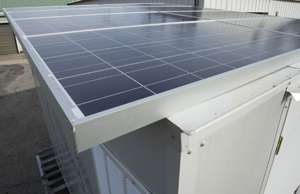
Spoilage of harvests on their way to market contributes to food shortages in India. A UC-industry partnership has produced an innovative solar chiller container and distribution plan to change that.
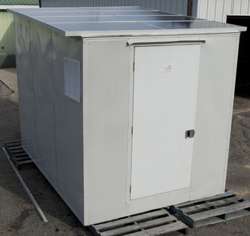
A new product is set to roll out in India. It's a food-storage device that uses solar panels to cool produce and preserve crops on their way to market, needed in India where 30 to 40 percent of the harvest is lost because of the lack of cold-chain facilities to store and transport food.
This sustainable fix in the form of the SolerCool container and a business plan to successfully launch the innovation is possible thanks to University of Cincinnati-industry partnerships.
According to India's Global Cold Chain Alliance, India is second to China in a food production industry worth $180 billion, but the waste of food due to spoilage leads to a huge shortage.
That problem came to the attention of faculty and students in UC's Carl H. Lindner College of Business during a virtual trade mission in July 2011. MBA students, led by Ilse Hawkins, adjunct associate business law professor in the Lindner College of Business, then followed up with a December 2011 trip to the Global Cold Chain Alliance Expo in Mumbai, India. That trip, in turn, has now evolved to a late 2012 product launch to provide a cool solution to a societal issue.
The new SolerCool venture has been developed as a solar generator that can store energy. Mohsen Rezayat, chief solutions architect at Siemens UGS PLM Software and adjunct professor in UC's College of Engineering and Applied Science, is primarily working on the engineering of the solar panels in the SimpliCool cube.
UC's Hawkins and current MBA students Ruma Dubey and Lillian Rice have helped to move the business plan forward from preceding students in the fall 2011 term. They are working in partnership with SimpliCool Technologies International LLC in Waynesville, Ohio, for a cold storage business venture in India.
"The goal is to have a distribution plan in place by the end of March and a unit tested by June," Hawkins says, adding, "It's the most exciting work I've done at UC."
John Borchers, CEO of Simplicool Technologies International LLC, agrees. He is currently in India to test SolerCool at an aloe farm.
"Occasionally in life and in business an opportunity comes along that has the potential to benefit small businesses and have an enormous impact on improving the lives of people in developing regions of the world," Borchers says. "The Cold Chain initiative and the graduate course Ilse Hawkins has developed at UC have combined to create such an opportunity."
BACKGROUND
Hawkins became involved in the cold chain initiative after hearing Joseph Dehner, an attorney with Frost, Brown and Todd, give an interview about a virtual trade mission between local businesses and Saudi Arabia.
Dehner, who chairs the India U.S. Business Network, invited Hawkins and her MBA students to work on a solution to India's Global Cold Chain issue. Hawkins and her graduate students partnered with executives from three local companies – John Borchers, CEO of SimpliCool Technologies International LLC; Doug Tyger, COO of Acutemp Thermal Systems of Dayton, Ohio; and Trent Fisher, CEO of SAS Automation in Xenia, Ohio, for a virtual presentation to Khanna and partner companies in India. Khanna liked what he saw and invited Hawkins and her students to attend the Global Cold Chain Alliance Expo in Mumbai.
With help from a P&G Higher Education Grant, Hawkins, along with eight MBA students (two from summer 2011 term, six from fall 2011 term) and fellow Lindner College of Business Accounting Professor P.K. Sen (now retired), made the December 2011 trip to India, where they toured a cold storage facility and made a case presentation with students at the Eastern Institute of Management on the role of foreign businesses in developing cold chain in India.
The then students (now graduates) Hajruden Efendic, MBA '11, Randy Martiniz, MBA '11, and David Timko, MBA '11, helped with the initial feasibility calculations. Efendic, who developed two patents for Siemens, is now working on a PhD in electrical engineering in Austria.
"I still think the idea is feasible and that there is significant potential for it in India," Efendic says.
At the expo, students attended seminars, spoke with representatives from various Indian companies and distributed brochures to foster interest in the Cincinnati area companies to further facilitate doing business abroad.
The UC participation created a lot of interest, Hawkins says.
"They were the youngest to attend the expo and the first group of students from the U.S.," Hawkins says.
Provided by University of Cincinnati


