Pygmy mole crickets don't just walk on water, they jump on it
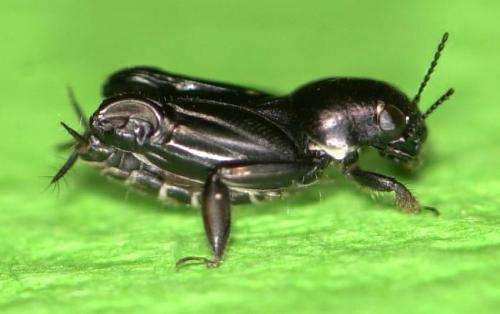
Pygmy mole crickets are known to be prodigious jumpers on land. Now, researchers reporting in the December 4th issue of Current Biology, a Cell Press publication, have found that the tiny insects have found an ingenious method to jump from the water, too. Their secret is a series of spring-loaded, oar-like paddles on their back legs.
"Pygmy mole crickets have solved the most difficult task of jumping from the surface of water," says Malcolm Burrows of the University of Cambridge. "For small insects, water can be a deadly, sticky trap: water grabs and holds an insect, offering it as an appetizing snack for an alert fish. Pygmy mole crickets turn the stickiness of water to their advantage and use this property to enable jumping."
Burrows came across this unique cricket behavior one day while sitting by the side of a pond in South Africa eating his lunch. He heard some odd noises coming from the direction of the pond and, after getting a closer look, discovered some insects jumping from the water toward the bank. He did what any good scientist would do: he caught a few and took them back to the lab, where he and colleague Gregory Sutton could catch their talents on high-speed film.
That's when he discovered the insect's oar-like paddles on its legs, which are spring loaded with a protein called resilin that Burrows says is "the perfect elastic." As those oars penetrate the water, they fan out. The crickets then "grab" a ball of water, sending it downward as their bodies soar in the opposite direction and to safety.
This curious bug strategy might even have some practical use.
"If we want to make small robotic vehicles that move under water, this is how we would have to design propellers or oars," Burrows says. "We would also have to use a material as good as resilin to impart elasticity, restore shape, and reduce drag."
In the meantime, the discovery is yet another example of amazing animal feats.
"This is an animal that has to do many things with its legs: dig burrows in the ground, jump rapidly to escape predators on land, and get itself out of water before it is eaten or drowns. It has solved a hugely difficult problem with a multifunctional mechanism that can propel jumps on land and water."
More information: Burrows et al.: "Pygmy mole crickets jump from water." Current Biology, DOI: 10.1016/j.cub.2012.10.045
Journal information: Current Biology
Provided by Cell Press


