December 1, 2012 weblog
A father attempts DIY drone buddy to watch his kid
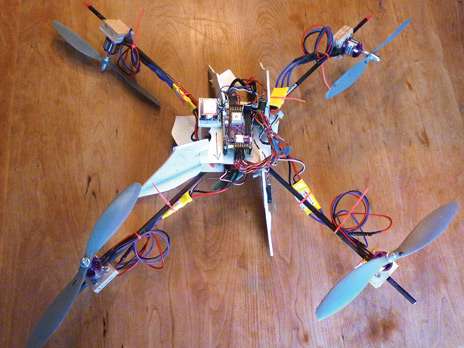
(Phys.org)—"Last winter, I fantasized about sitting at my computer while a camera-equipped drone followed him overhead." That is the revelation of a father who provides a detailed account of building an Arduino-based gyrocopter that could follow his son, in grade school, who he normally walks 400 meters down a hill to the bus stop each morning. He chose a quadcopter design for its maneuverability and ability to hover. He did not buy a kit but instead got his parts separate. His project involved a central frame to hold the electronics, aluminum to support motors and propellers, and legs to cushion landings, a main control board and sensors, batteries, power distribution board, power controllers for the motors, radio receiver for standard remote-control flying, and an RF modem for computerized control.
Paul Wallich, an IEEE Spectrum contributing editor shared many details behind his DIY device with the magazine. He chose an ArduPilot Mega for the main control board. ArduPilot Mega is a fully programmable autopilot that requires a GPS module and sensors to create a functioning Unmanned Aerial Vehicle. He said the whole board is powered by a 5-volt feed from one of the motor controllers. He installed Mission Planner on a Windows desktop to initialize the ArduPilot Mega's firmware and calibrate all its sensors and controls.
He decided against using RFID systems, opting instead for a GPS beacon. "Reading an RFID tag from meters rather than centimeters takes more amplification and a fancier antenna than I was willing to have my quadcopter carry."
How successful was he? Getting the thing up in the air was trivial. But he still had to rate his success based on how it worked. He said it "mostly" worked. Windy conditions were a problem, making the copter skittish. GPS guidance was good to ten meters at best.
"Because my particular front yard is only about 15 meters across, with a long, tree-edged driveway leading to the street, I either have to follow automatically above the treetops—where I can't really see what's going on—or else supplement the autopilot with old-fashioned line-of-sight remote control." Wallich said he plans more sonar units for "collision avoidance," and maybe an optical flow sensor for better position control.
He discovered another difficulty, rechargeable battery life. "Just hovering in the air requires two to three amperes; moving around or fighting a breeze expends twice that or more." He said the typical 2200-milliampere-hour lithium-ion battery gave him just enough time to fly to the bus stop, wait a few minutes for the bus and fly back.
More information: spectrum.ieee.org/geek-life/ha … iy-kidtracking-drone
© 2012 Phys.org


