December 9, 2012 weblog
Missing data on Earth's magnetic field is in the oven
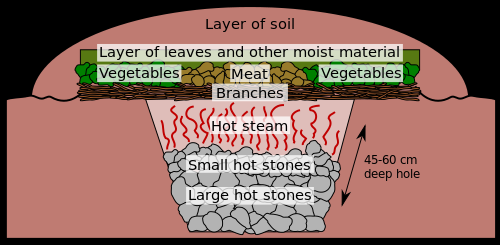
(Phys.org)—A New Zealand research team hopes to retrieve missing parts of a puzzle about the Earth's magnetic field and changes to it over time. Grabbing their attention are the stones that line Maori steam ovens. They want to learn more about how those ovens may give them missing data about the magnetic field. The idea is that the cooking process generates so much heat that the magnetic minerals in these stones will realign themselves with the current field direction. Examining the stones may explain more about the Earth's magnetic behavior. The archaeological search in New Zealand is out to find sites containing the old "hangi" ovens.
Radiocarbon analysis of the charcoal left from the firewood used to light the oven may provide the date recovered with the stones. Dr. Gillian Turner of Victoria University, Wellington, New Zealand, recently discussed her project at the American Geophysical Union (AGU) Fall meeting. She told BBC News, "We have very good palaeomagnetic data from across the world recording field strength and direction - especially in the Northern Hemisphere." Nonetheless, the southwest Pacific is a gap that makes the global models incomplete. That is why she and her team are out looking for "good, high-resolved data from our part of the world."
To define changing directions and intensities, mathematical models require data from many points of the Earth's surface. Scientists focusing on the magnetic field do so for fundamental reasons. "We use the magnetic field to navigate and it protects us from the solar wind. We still don't understand the origin of the field, but the geological record tells us that it changes its intensity on relatively short timescales and sometimes dramatically reverses its direction," she has written.
The first settlers on New Zealand were the Maori. They used steam ovens for cooking, in the form of placing hot stones, food and layers of fern fronds soaked in water into pits in the ground, then covered with soil, for several hours of cooking. They chose the stones carefully, including andesite boulders, considered ideal because fire could not crack or shatter them. Dr. Turner said they were also ideal for research purposes because they behave better magnetically.
She said by putting thermocouples in the stones the team found that the temperature got as high as 1,100C. "At that temperature, rock-forming minerals start to become plastic if not melt." A compass on top of the cooled hangi stones established that a re-magnetization had taken place.
Her team is also looking at other potential sources of information including volcanic rocks and lake sediments. Once the project is complete, Dr Turner hopes the research will help scientists to understand how the earth's magnetic field might change in the future.
More information: www.royalsociety.org.nz/2011/10/06/turner/
© 2012 Phys.org


